
24/08/2026
In this edition of Meet the Team, we are catching up with Elham Ebrahimi, who joined the Trinity Village Estate team as Assistant Accountant at the start of the year. From what first drew her to the role to what she enjoys doing outside of work.
What does your role at Trinity Village involve and what does a typical day look like?
On a typical day, I support financial operations in my role as Assistant Accountant by supporting with budgeting and cash reconciliations. I collaborate closely with the purchase ledger and treasury teams, manage utility and council tax invoices and resolve related queries. Additionally, I assist with administrative and ad hoc support to the onsite team.
What first attracted you to Trinity Village and how long have you been with the Estate management team?
I was looking for a role which could provide me with an opportunity to progress. I joined Trinity Village in January this year.
What's the most rewarding part of your job at Trinity Village?
For me, the most rewarding part is achieving full control over my workload by clearing out old backlogs and keeping all current tasks completely up to date.
What do you think makes Trinity Village stand out from other parts of London?
Because our office is situated right on the Estate, we have good proximity to our tenants. This gives them great peace of mind, knowing that if a problem ever comes up, they can just pop into the office and we will fix it quickly for them.
Do you have a favourite spot within Trinity Village?
Trinity Church Square is my most loved spot - it's where we hosted our Pimm's in the Square gathering, too.
Where do you like to grab lunch nearby?
I prefer to bring lunch from home, but I have tried Mercato Metropolitano and I quite liked it.
How do you unwind once the working day is done?
After work, I like to head out and do a workout.
What do you like to get up to in your time off?
My favourite thing to do is to travel. I particularly like to visit seaside spots.
If you had a perfect day in London, what would it look like?
My perfect day would start with waking up early and a walk to Regent's Park, which takes about 40 minutes from where I live. I would meet some friends there, followed by a lovely lunch in a nice, cosy restaurant. Later on in the afternoon, I would visit a gallery or exhibition, then on to the gym. I'd round off the day by returning home for a peaceful evening, winding down with a good book.

08/06/2026
Canine residents Dennis and Patch haven't been part of the Trinity Village community for very long, but get to know their quirky personalities and what they get up to day-to-day as owner Paul Price tells us about their backgrounds, funny habits and job roles they'd most likely take on.
What are your pets' names and what is the story behind why you chose these names?
Dennis and Patch. Dennis started off as a tribute to Dennis from It's Always Sunny in Philadelphia, as one of us is a big fan of the show, but it didn't take long for him to grow into Dennis the Menace, too. Both fit, honestly. Patch's name came with him: when we found him in Mauritius, he had a fungal infection on one eye that made him look like he was wearing an actual eye patch.
What breed are they?
Dennis is a cockapoo. Patch is a Mauritian street rescue, so his breed is a bit of a mystery.
How old are they?
Dennis is six and Patch is around 20 months old.
How long have they been part of the Trinity Village community?
Just over two months. We moved here from Mauritius recently, so they're still very much settling in, and so are we.
How would you describe their personality?
They couldn't be more different. Dennis is wildly confident, almost too friendly and completely ball-obsessed. He also has ridiculously long eyelashes (he might win the world record). Patch is the opposite: shy at first, nervous around new people and dogs because of his rough start in Mauritius. But once he warms up, he's the most affectionate dog you'll ever meet. He's an extreme licker - kisses are his love language.
Do they have any funny habits or quirks?
Patch has these incredibly long, skinny but surprisingly muscly legs and he can stand fully upright on his back paws. Dennis, being a cockapoo, absolutely cannot, so seeing them next to each other when Patch stands up vertically is genuinely one of the funniest things in our house. And Dennis is a bit of a thief, especially sandwiches. He once stole an old lady's entire picnic off a bench in Greenwich Park (we're still apologising).
What is one thing that they do that makes you smile?
Honestly, just watching how far Patch has come. Almost two years ago we paddle-boarded out to a tiny uninhabited island off the coast of Mauritius and found him there with two other puppies. They had been dumped there to die. We rehomed the other two and kept Patch. Seeing him now, snoozing on a sofa in London after everything he went through, is the thing that gets us every time.
What do they most enjoy about living at Trinity Village?
We've come from open-plan, outdoor living in Mauritius (think sunshine, garden doors always open), to a third-floor flat in London - it's a big change for them. The parks and green spaces here have made the transition so much easier and people have been incredibly warm. They're also obsessed with window watching, especially the squirrels running across the gardens.
Do they have any favourite spots around the Village?
Dennis loves the local dog park: squirrels, balls, friends - it's his paradise. Patch is still finding his confidence, especially around other dogs, so we stick to quieter local walks with him for now and take introductions slowly, but he's getting braver by the week.
What does a typical day look like for them?
We all wake up together, then it's full mayhem in the kitchen with lots of zoomies and wagging bums in anticipation of breakfast. After that, we take them downstairs for a walk and toilet break, which is the biggest adjustment of all for Patch. In Mauritius, he could wander outside whenever he needed, so the concept of "holding it in" until someone takes him down is still a work in progress. The rest of the day is mostly playing, napping, window watching, dinner and another walk. It's a hard life.
If they were to be employed by Trinity Village, what roles would they take on?
Dennis would be CSO (Chief Squirrel Officer). He'd spend his days monitoring tree-based threats from the office window. Patch would be Head of Licking. Pastoral care, basically.
Have they helped you connect with your fellow residents/do they have any neighbourhood pals?
Definitely. We've started recognising a few regulars around and it's amazing how quickly you go from nodding at someone to knowing their dog's full backstory.

24/03/2026
In this feature, we celebrate the wonderful furry residents who share our Estate and bring plenty of character to everyday life in our community. We’ll be introducing some of the beloved animals who live alongside us here at Trinity Village, along with the residents who care for them. First, Estate Director Louie-Mae Gibson introduces her two canine companions and colleagues, who keep her company at the Estate Management office and at home.
Names
Boris (or Bobo) and Bertie (or Hippo/Thuglife)
Breed
French bulldogs
Ages
Boris is 8 and Bertie is 4
How long have they been working at Trinity Village?
Boris was first onboarded in October 2019 and has since made remarkable progress around the office. Over the years, he has firmly established himself as a valued member of the team, bringing plenty of personality and enthusiasm. Not long after, the team decided to expand the division. Bertie joined the ranks in 2022, following what can only be described as a very thorough selection process. Since then, the pair have worked closely together, ensuring morale stays high and that no unattended snack goes unnoticed.
What does a typical day look like for them at Trinity Village?
In the mornings, they are absolute sleep monsters, usually found curled up in their baskets enjoying a very serious snooze. By around midday, however, the energy levels rise and it’s time to head out for their daily adventures, where they love meeting some of the other four-legged residents of Trinity Village.
Their favourite destination is both Trinity Church and Merrick Squares, although they are still trying to come to terms with the fact that they’re not actually allowed inside — a rule they continue to question with great determination!
Most likely to be found…
Boris is partial to a squirrel chase, so you’ll likely find him carrying out strict checks of the area and if one comes into sight, you’ll know where to find him.
Bertie on the other hand is a lounge lizard and his interests mostly lie in snoozing and snacking.
Describe their personalities
Boris being the more mature counterpart of the pair, is a delicate soul. He is a quiet pooch and very gentle in nature, but this has always been his natural demeanour, even from day 1 of bringing him home as a puppy – he hasn’t changed much.
Bertie on the other hand is a bit of a loveable lump. Affectionately nicknamed Hippo and occasionally Thuglife, he is known for his big presence and laid-back attitude. That said, he also has a softer side and has perfected the classic puppy dog eyes whenever he’s in the mood for a little extra attention, but we’ll keep that one a secret to protect his street cred.
Both Boris and Bertie are typical Frenchie characters. They will brighten up your day with their funny quirks and are extremely loyal and loving. Their inquisitive nature means that you can never feel lonely as they forever stick by your side.
What’s their favourite walking route nearby?
Boris and Bertie love the scenic surroundings within Trinity Village, so a couple of laps around Trinity Church and Merrick Squares remain a firm favourite, culminating at the Roebuck for a few doggy treats for their good work and also a spot of lunch for their human.
Favourite local treat?
Both doggos are quite lucky in that the very generous dog-pawrents of Trinity Village are always willing to share their treats with them. Their treat radar is quite impressive and they manage to pull the neediest face at the mere rustle of a snack packet, and so are highly skilled at sourcing local snacks. This means that I must also be on my treat A game, so that I can return the favour to the four-legged creatures of Trinity Village.
If you and your pet would like to be included in the next Pets of Trinity Village segment, please get in touch at info@coverdalebarclay.com

03/02/2026
Could you tell us a little about your role at Trinity Village and what a typical day involves?
I work behind the scenes on our maintenance portal, Fixflo, which many of our tenants will be familiar with. My role involves liaising with tenants who report issues and coordinating with our on-site team to ensure problems are resolved as quickly and efficiently as possible.
What originally drew you to Trinity Village and how long have you been part of the Estate Management team?
My journey to Trinity Village has been an interesting one! It started in June 2022 when I interned at Knight Frank’s head office. Towards the end of my internship, I learned about some temporary positions available for the Summer. I applied and was offered a role at Trinity Village because they felt it would be the best fit for both me and the team.
After the Summer, I was offered a permanent part-time position as Estate Administrator while I completed my university studies. Once I graduated in 2025, I briefly left for a full-time role elsewhere, but within a couple of months, I was fortunate enough to return to Trinity in my current full-time role as Facilities Management Coordinator.
What do you enjoy most about working at Trinity Village?
Without a doubt, the people! The team and the tenants have been warm and welcoming throughout my journey here.
In your view, what sets Trinity Village apart from other residential areas in London?
Although I’ve never lived in London myself, I’ve rented in other places, and two things really stand out about Trinity Village. Firstly, having an on-site management team is incredible; being able to report issues and have them resolved quickly is a huge benefit. Secondly, the private gardens and green spaces are such a luxury in London, especially during the warmer months.
Is there a particular area of Trinity Village that you love most?
Definitely the Trinity
Church Square Garden. I especially love it for the events that are run for the tenants, it creates a real sense of community, which I truly admire.
What is your favourite lunch spot in the local area?
I’m not sure I have a go-to lunch spot yet, but I can confidently say my favourite pit stop on the way to and from work is Tiam London, the bubble tea shop on Harper Road.
How do you like to relax after a busy day at work?
With a pizza and my feet up on the sofa – simple but perfect.
When you’re not working, how do you enjoy spending your free time?
I love exploring, whether it’s traveling to new countries or discovering hidden gems in the UK. I’m always on the lookout for great scenery.
What would your ideal day in London look like?
It would have to be a day dedicated to visiting all the Christmas markets around the city. There’s something magical about London during the festive season!
03/12/2025
This month marks six years since our Estate Director Louie-Mae Gibson joined Trinity Village. This milestone reflects her dedication, leadership and care for both the Estate and its residents. Over that time, she has overseen major improvements, strengthened community relationships and helped preserve the heritage and beauty that make Trinity Village such a special place to live.
Reflecting on what first attracted her to the role, Louie-Mae shares that "After working for large corporate firms and developers, working for a charity (Trinity House) gives you purpose. Then after walking around the Estate, I saw how beautiful it was, and I was sold."
The early days were, in her words, "full on." With layers of history and established processes to navigate alongside maintenance and safety priorities, there was plenty to get to grips with. Yet six years on, the Estate has really evolved and she credits her "amazing team" for their hard work and commitment.
"The Estate looks the best it has in nearly 50 years, so I’m kindly told," she says proudly. "The huge improvements in maintenance reporting and external/internal Planned Preventative Maintenance (PPM) works have made a difference".
Community is at the heart of Trinity Village and one of her proudest achievements has been the annual Pimm’s in the Square event, which began as a simple post-Covid gathering and has grown into a much-loved local celebration with over 250 attendees this year. "It has evolved into an amazing community event, bringing everyone together, not just Trinity residents, but other local people too", she says.
With regards to the biggest changes she has seen during her time here "The relationships that the management team have with our residents and the TNRA", she says. "From fractured beginnings to where we are now, the transition is down to hard work, trust and respect".
Louie-Mae also highlights the restoration and upkeep of the gardens as one of the key developments that stand out to her. "The gardens are also beautiful after 5 years of having Penny Hinves as our Head Gardener. They look amazing and are a demonstration of our care and commitment to the Estate, with financial investment and expertise, along with a glittering of love sprinkled in. They really are the jewel in the crown at Trinity".
From the King Alfred project to the creation of the Queen Elizabeth II and Prince Philip Memorial Garden, many of the Estate’s most meaningful developments reflect her commitment to heritage and remembrance. As a military veteran herself, she is especially proud of establishing the annual Remembrance Day commemoration, which she hopes "will continue for years long after I leave."
Looking back, she reflects on how the human element shapes her work. "Trinity residents are real people and deserve the best-in-class service we can humanly provide. These are people’s homes, their community. This is where their children grow up and continue to live. It’s extremely important that I bear this in mind when doing my work. It does make me take a breath and note the human element and have the ‘If I was them, what would I want?’ approach. In the early years, a lot that needed doing, be it regularising rent reviews, getting works done, making the properties safe and maintained and at times I forgot some of that. Now I am in the groove and know that I care and serve the residents and the charity as kindly and best I can".
Over the past few years, the Estate has evolved considerably in both its operations and resident experience. "From introducing new software platforms to expediting and executing maintenance issues, there has been a lot of transformation. We totally changed the installs and roof works so they are now more sustainable and have better insulation that’s longer lasting and cheaper for residents. There are now more efficient move-in procedures and clearer rent review processes, and this very e-newsletter has become snappier and more engaging".
Managing a historic Estate brings its own challenges and it takes great knowledge and skill, but she views the task of caring for these listed buildings as a privilege. "Leaks and roofs! It never stops!" she laughs. "The older buildings are very complicated to look after. Works can be technically very challenging, so you have to know your apples. We always strive to be sympathetic to the buildings, and it is done with great care".
"There are no quick wins," she admits. "It takes genuine care to make sure we are the very best custodians of the Estate and will make sure the heritage is not destroyed or forgotten and very much loved".
When asked what the most rewarding part of her role has been, she goes onto say, "The residents enjoying their homes and gardens and my team doing well and being recognised. I love walking the Estate or visiting homes and seeing how wonderful it all looks and knowing residents have beautiful homes that they can come home to at the end of the day, knowing that they are well looked after".
Celebrating Louie-Mae’s six years at Trinity Village, we mark her dedication to making the Estate an even better place to call home.

03/12/2025
Trinity Village has long been home to a diverse and creative community, and this month we meet one of our residents bringing powerful storytelling to the stage. Theatre director Joe Gilmour has recently returned from directing his latest play, Block the Block (written by Nathaniel McBride), a documentary-style production which shines a light on how ordinary people challenge the systems shaping their homes and cities. We caught up with him to learn more about his work.
Firstly, how long have you lived in Trinity Village?
I have lived in Trinity Village since 2023, when I moved from Manchester to do my masters in Theatre Directing.
Can you tell us a bit about your experience as a theatre director and your most recent play?
I have been working as a theatre director since 2016, initially in Manchester where I worked a lot with two wonderful theatres, the Royal Exchange and Bolton Octagon, mainly working on Youth Theatre and community projects. Both theatres are beautiful, so I recommend a visit if you are ever in Manchester! I then wanted to widen my experience so the last few years I have worked as an assistant director, including on Evita and A Chorus Line. Now I’m back to freelancing on my own projects, with theatres and drama schools across the country.
What first inspired Block the Block?
The most recent play I directed was called Block the Block, by Nathaniel McBride. It tells the story of social housing residents in Manchester launching a campaign against a huge tower block being built in their area – not dissimilar to the Borough Triangle development. Nathaniel is a housing campaigner who uses theatre to raise awareness of the processes that govern us and shape how we live our lives. Housing is a human right yet so few of us understand how decisions are made about which buildings get built.
Nathaniel’s first play Dictating to the Estate examined what led to the Grenfell Tower fire. This inspired him to explore other housing campaigns and he moved to Manchester to write a play on the very successful Block the Block campaign in Hulme. Because his work is always verbatim – a form of theatre where every word has actually been said by the people involved – he started recording interviews with local campaigners, which were then mixed with the transcripts of the planning committee meetings to form the play.
How did you go about turning planning committee minutes and campaigner testimonies into theatre?
I see the job of director as taking the intention of the playwright and making sure it is delivered to the audience on the night. Nathaniel’s intention was clearly to explain the arcane and opaque ways in which the planning process favours the powerful. It’s very unusual for a play to be focused on explaining processes and not character journey, so I was nervous about that. I believe all audiences want is to connect to the human beings on stage, but it turned out the interviews that Nathaniel had made portrayed the characters very compellingly, and that drove the play.
We had a week of Research and Development in Manchester to experiment with the actors and find ways to bring the planning meetings alive. I’m pleased to say that after lots of work, discussions, thinking and with the help of our brilliant sound designer Patch Middleton, I believe we really succeeded in this. Audiences leave the play saying they fully understood and were gripped by the planning meetings, something I was worried we might never achieve!
How did audiences in Manchester respond to the play?
Every time we’ve shared the play it’s had a moving and special response. In Manchester, we had a very special evening where the campaigners came to see themselves on stage, which was very moving. Other housing campaigns have also come to see the play and have taken strength from seeing the fight in Hulme. But most exciting to me are the audience members who at the start of the play have never really thought about planning law and by the end they leave with a new energy to question and challenge the system.
What was it like bringing Block the Block to London?
We were asked to perform the play at the first ever Arts Action Festival at Rich Mix on 25th October. I was wondering whether the play would have the same power outside of Manchester. In actual fact, the story of these campaigners connected beautifully with London audiences and the response was incredible. It felt very special to be able to share this local story beyond Manchester and our hope is to share it more widely. We’ve spoken to Tenants Unions in Spain and if we could ever perform it over there, it would be amazing to see if this Mancunian and British story could help inspire campaigners in other countries and systems.
Has working on this project changed your own perspective on housing issues and activism around that?
I was already interested in politics, but I’m left in awe of these campaigners who have an endless well of optimism to continue fighting. The campaign has had considerable knock backs but somehow when I talk to campaigners, I leave feeling energised and uplifted. I think we all need a bit of that at the moment.
What do you find most rewarding or challenging about producing theatre with such strong social and political themes?
This is the most political piece I’ve made and it’s definitely changed me as an artist. The most thrilling thing is watching audiences come out and not actually talk about the play itself but about how the story relates to the change they would like to see in their own communities. That’s extremely motivating. Theatre is challenging to make because there is never enough time or money. But when I see audiences respond to pieces like this, I think it’s absolutely the most worthwhile thing I could be doing.
Do you feel there are parallels between Hulme’s story and issues facing London communities today?
You don’t have to look very hard to see the parallels. Controversial developments are being proposed all over London, from Elephant and Castle to Clapham to Peckham to King’s Cross. To be clear, the play is not about stopping things from being built, it’s about fighting for a planning system that responds to the needs of the people, not just helping those with money make even more money. This lesson applies even more so to London than Manchester!
What’s next on your creative horizon after Block the Block?
Next, I am working as Resident Director on Daniel’s Husband at the Marylebone Theatre. This is a story about a gay couple whose life is turned upside down, leading them to question the very nature of love.
I am also planning to take what I have learnt from Block the Block and create a piece of children’s theatre, that engages them in politics. It’s called The Pigeon Who Became Prime Minister and will be a fun way for kids to learn about how democracy works.
Do you see yourself continuing to explore documentary theatre or branching into other styles?
We are already starting work on Nathaniel’s next play about Seven Sisters and College Bank in Rochdale – a town with a social housing list of 22 000, yet the local housing association is knocking down homes rather than building them.
What do you enjoy most about living in Trinity Village?
I feel very lucky to live in Trinity Church Square – I love the garden especially when the cherry blossoms are out. I’ve also got involved with Trinity and Newington Residents’ Association, which I highly recommend doing! It’s allowed me to get to know more people in the area and I’ve got huge respect for everything they have achieved for the Village over the last fifty years – from traffic calming to fantastic pub quizzes. The sense of community is one of the most special things and seems increasingly rare in London, so we need to keep building it stronger and stronger!
Does the Village and its history inspire your creative work in any way?
I have discovered that Trinity Village has a long history of growing successful theatre directors – with Sam Wanamaker, the driving force behind rebuilding Shakespeare’s Globe in the 90s, and Sam Mendes, former artistic director of the Donmar Warehouse and director of multiple James Bond films, both former Village residents. So, I’m hoping some of the Trinity Village luck will rub off on my own career, even if I’m not called Sam.

Cast and Campaigners at Contact Theatre, Manchester in March 2025, by Debbie Beeks
04/09/2025
We had the great pleasure of meeting 87-year-old local resident, director and actor Robert Pennant Jones. Taking a pew with him at his beautiful, character-rich home in Merrick Square, we discussed his extensive work and enduring presence in the world of theatre throughout the course of his life.
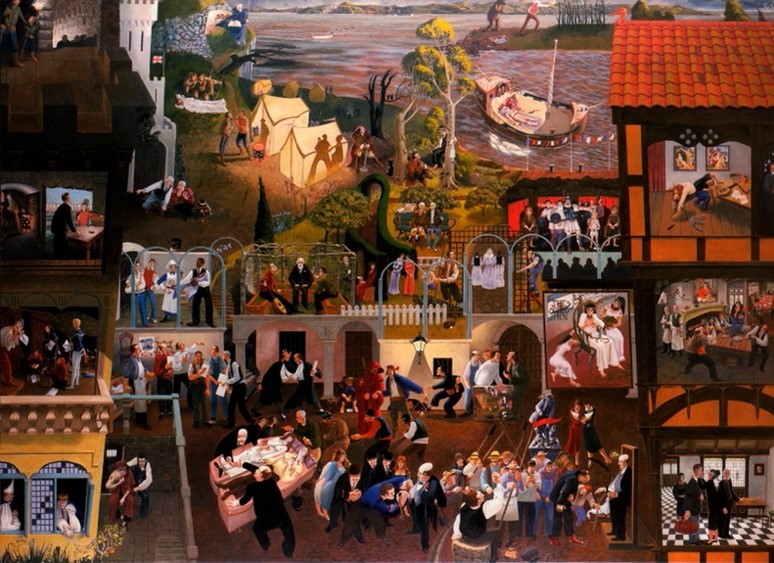
The last time we spoke to Pennant Jones in 2023, we discussed his retirement present to himself: a ten-foot by 8-foot painted work by fellow friend and artist Ronnie Copas. The Poet and the Painter (the poet in question being Shakespeare and the painter being Copas), comprising 37 incidents from Shakespearean plays chosen by Pennant Jones and painted by Copas. This remarkable piece of art was originally exhibited at the Royal Shakespeare Theatre at Stratford-upon-Avon (where a catalogue of the work was produced around the same time) and then went on a tour with the Royal Shakespeare Company in Newcastle and in Plymouth. It was also taken to the King’s Lynn Festival before it went back to London, where it is now on permanent loan at Shakespeare’s Globe.
The Globe subsequently gifted Pennant Jones a high-quality print of it, which sits proudly and regally on his living room wall. Commanding quite a presence, he recounts a moment in the past where his granddaughter invited her friends to his home and suddenly illuminated by the lights in a dramatic moment, the painting bestowed itself upon its guests in a very theatrical way, prompting a great response from them. Asking how the piece had been received since its completion 20 years ago, he humbly recounts, "I think it’s alright". Having toured the country, sold catalogues and now in the Globe’s possession, it is safe to say this impressive piece of work has made an impact and it is something Pennant Jones wants to be remembered by. It has certainly paid homage to his life-long love of Shakespeare.
Speaking to Pennant Jones about his favourite incident from the painting, he points to the top as our heads tilt back to catch a glimpse, where ‘Exit, pursued by a bear’, a famous stage direction in Shakespeare’s The Winter’s Tale, is depicted. Pennant Jones has had much experience with this production, having taken it to France and rehearsed it at the Tower Theatre in London. In the play, Antigonus is tasked by the King with leaving the baby Perdita behind, but his mission takes a dramatic turn when a bear suddenly appears in his path. The old man sacrifices himself to save the baby and is eaten by the bear. "This is Shakespeare at his most profound", he says. "Thou met us with things dying, I with things newborn", he continues – a truly powerful and reflective moment, both in the play and in the interview.
When we asked Pennant Jones whether the piece had turned out how he first envisioned it or whether it evolved along the way, he says, "I didn’t know whether Ronnie was going to do 37 pictures, or three pictures of 10 incidents, or one picture of 37 incidents". Ronnie spent a year thinking about the project before he began to change his studio to accommodate something as large as what was produced. There had also been a couple of changes in the chosen scenes for the painting, so plans naturally progressed and changed over the three-year period during its preparation. Pennant Jones describes seeing the drawings for the first time whilst they were formulating the work and sharing ideas. "They had fax machines in those days, not computers" and eagerly anticipating the emerging drawing, "it was like a child being born".
Enquiring whether Pennant Jones had collaborated with any other artists, he tells us about Paul Birkbeck, a friend of Copas. Pennant Jones worked on a film script that he prepared for a version of Pericles by Shakespeare, which he calls Fathers and Daughters. He co-directed a production of Pericles for the Classic Stage Company (CSC), an Off-Broadway theatre group. Paul Birkbeck created 6 pictures, including portraits of the contending Gods and illustrations of other key scenes. Though prepared for the film version of the play, so far unmade, these works still remain.
"If you could choose another literary figure (apart from Shakespeare) to centre a project around, who would it be?", we asked, and swiftly he replied "Christopher Marlowe, Samuel Beckett and the anonymous Gentleman of Cambridge", whose portraits adorn the cover of his most recently published book Red Letter Words. During Pennant Jones’ lifetime, he has directed and acted in over 60 productions of the aforementioned playwrights, and the book explores the projects that have since transpired as a result. "I’ve directed and appeared in Beckett’s plays and directed one of the greatest plays Tamburlaine the Great by Marlowe in 1964", which happened to be both Marlowe and Shakespeare’s 400th birthday, contemporaries of one another. "I was the only person that year to direct a Shakespeare and Marlowe play – that was a great achievement for me". Talking about Beckett, he says, "I appeared in Endgame, along with Happy Days, which I have written about in the book". In his book, he also tries to identify the anonymous author of The Lady’s Preceptor, a 1743 pamphlet and embarks on detective work to reveal the enigmatic figure he so admires.
Red Letter Words is another project Pennant Jones wants to be remembered by. "Theatre is very ephemeral", he says, "so there is no real memory". While theatre is fleeting by nature, Pennant Jones’ book serves as a way to preserve his legacy — something more permanent that will outlast the stage. There are a few snippets of spoken performance in the book that can be listened to via QR code, which further immortalises his work.
Pennant Jones has worn many hats in his lifetime and when we asked what he considers himself to be, he tells us, "I was/am a businessman but started off acting at university and thought I was the best actor in the world", he narrates with a smile on his face. "But I was in a cast with Derek Jacobi, Ian McKellen, Margaret Drabble, Tom Fortune and various other people who went onto distinguished careers in the theatre" – he was indeed in great company. Pennant Jones refers to himself as a "non-professional, I hate the word amateur" – spending his days perusing his theatrical passions whilst funding them through his pragmatic work in business. The sheer volume of theatrical ventures and talent would suggest he is far from a ‘non-professional’. "I get to do what plays that I want to do, not what the management wants me to do and I get to play better parts than if I had been a professional actor". This sort of artistic freedom is truly priceless.
"And do you prefer directing or acting?", we ask. He pauses and ponders with a furrowed brow. "That’s a good question, I think probably directing. I’ve been able to put on the map several things that otherwise wouldn’t be out there. The production of Tamburlaine the Great, for example, was interesting and a couple of American plays in London. As I say, I’ve been very happy with my Becketts and Christopher Marlowes – so I would say directing".
Moving onto what projects he’s currently working on, he talks about his love of photography. "I have done quite a lot of travelling and am ruthless about taking bad photos. I take 50 and immediately throw about half away and then make a small print of those, throw away another half and then enlarge one or two pictures, and fill my photo books with enlargements of which I’m really happy with". This is indeed a far cry from the thousands of snaps that are taken on smartphones and forgotten about in the digital ether. Pennant Jones truly leans into the art of quality photography. "Another rule in photography", he says, "is it has to be of the moment and dynamism is what catches your eye and that’s the shot – I will take the picture candidly". In addition to shooting whilst travelling, he takes photos around Merrick Square, capturing charming corners and details of it. He has resided in Trinity Village since 1963. "For me, the centre of my existence is Trinity Village. It has been the perfect location for me – near my office, the theatre and all of the West End theatres, with plenty of room for my family. We’ve had four overseas postings of two years each, but we’ve always returned. It’s the centre of our universe and its perfect".
Speaking of local theatres, we ask whether he has been to any shows recently that have caught his attention. "I don’t go to the theatre anymore because I have more or less seen everything I have wanted to, and the modern stuff isn’t really written for people like me. But I did have one wonderful theatre experience of a production of Twelfth Night, which was my first production". He suddenly points to the window ahead and spotlights a beautiful piece of stained-glass art of a Balinese dancer, with the words, ‘O mistress mine’ included at the bottom, a line from the play. He abruptly swoops into character as he accurately recites: "O Mistress mine where are you roaming? / O stay and hear! your true love's coming, / That can sing both high and low; / Trip no further pretty sweeting". He shares his life with his wife of over 60 years Sheila, who he dedicates his previously discussed book Red Letter Words to in the first pages, "with love and admiration". He continues, "I inscribed Sheila’s wedding ring with this line because she is my mistress, my Mrs and my teacher"- a true love story.
Returning to the question of shows he has seen recently, "I don’t go to things that I have directed myself, unless there is very good reason or unless a friend is in it. I am great friends with Ian McKellan, for example, so I see all of his stuff".
He also mentions being impressed by the Richmond Orange Tree Theatre’s production of Twelfth Night, which starred Clive Francis and featured a grand piano as the central element of the performance, despite the small stage space. "Clive is a wonderful actor and a caricaturist", he says, as he points to a picture of Shakespeare on his wall, which features on the cover of his first book First Act Shakespeare, published seven years ago. Pennant Jones taught Shakespeare in schools and says, "The real way to understand Shakespeare is to act Shakespeare. If you can’t act Shakespeare, see Shakespeare. If you can’t see Shakespeare, read Shakespeare. And on no account, should you ignore Shakespeare!". He himself admits that Shakespeare’s language can be difficult to digest for the modern-day person. "But when you are given the chance to act it, you have to know what is being said and impart that to the audience. And even if the audience doesn’t know what half the words mean, it’s the actor’s job to convey them. First ACT Shakespeare", he says.
As the interview drew to a close, we rounded things off with a tour of his incredible home. Every room felt like a chapter in a fascinating story — a medley of paintings, literature and trinkets all jostling together in perfect harmony. He has a reasonable collection of art from the likes of William Dudely (who won seven Olivier awards for his stage designs at the National Theatre), Ronald Searle, Imogen Stubbs and John Monks, to name a few. He shows us around his photography books, featuring images from his travels, Merrick Square and landscape shots of Hadrian’s Wall and Stone Henge. We lastly stumble upon some of his photography of sun dappled Stratford-upon-Avon, Shakespeare’s birthplace, a full circle moment as we finish up the interview and the journey through his life.
"What’s next on the horizon for you in 2025 and beyond?", we ask. He gets into character once more. "The sixth age shifts / Into the lean and slippered pantaloon…/ Last scene of all, / That ends this strange eventful history, / Is second childishness and mere oblivion, / Sans teeth, sans eyes, sans taste, sans / everything" — a poignant excerpt from Shakespeare’s As You Like It. "I’m in the sixth age, moving into my seventh."
A highly accomplished director and actor, Pennant Jones warmly invites Trinity Village residents to his home to view his art and photography collection, and if anyone would like a copy of his books Red Letter Words and First Act Shakespeare, along with his catalogue of The Poet and the Painter, give him a call to arrange a visit on 020 7403 3121. If you can and would like, you can just donate the £20 cost of the books to your favourite charity.
If you are interested in being spotlighted in our ‘Meet your neighbours’ feature in future editions of the Trinity Villager, please contact us with some information about yourself to info@coverdalebarclay.com.


24/08/2023
On a recent trip to Trinity Village for the unveiling of Queen Elizabeth II’s memorial plaque, Deputy Master of Trinity House, Captain Ian McNaught CVO NVM, had the pleasure of visiting the residence of Robert and Sheila Pennant Jones, in Merrick Square.
During the visit, Captain McNaught was lucky enough to view the artwork of the Pennant Jones’ and Lambeth artist Ronnie Copas, depicting scenes from the works of Shakespeare.
After Robert and Sheila saw the Van Eyck brothers’ 1432 masterpiece, The Adoration of the Lamb in Ghent, Robert was inspired to embark on his project - "The Poet and The Painter".
Robert contacted Ronnie, who he and Sheila had previously purchased art from and developed a relationship with, and soon drew up plans for the project: a painted work of art depicting a pivotal scene, or "moment", from each of William Shakespeare’s 37 plays. Robert was to carefully select the key scenes and direct their "staging", and Ronnie was to be the one to bring the ideas to life on canvas.
After one thousand and three days since the initial conception of the idea, Robert, Sheila and Ronnie’s toil had come to fruition, with the pivotal moments from Macbeth, King Lear, The Tempest, and many more, immortalised in one grand painting dedicated to the Bard of Avon.
To view the painting in full, with a scene-by-scene breakdown, please see Ronnie Copas’ Website here.
02/03/2023
As we are a community here at Trinity Village, we would like to invite you to get to know your estate management team. Vaidas Prichodka became the Assistant Facilities Manager at Trinity Village in mid-April 2022 and is responsible for reactive maintenance around the estate.
It is not a role without its challenges, and Vaidas notes that while the size of the estate certainly is one of those challenges, it is also one of the best things about the job. Supporting over 270 homes, is certainly something to be proud of. Vaidas is employed through Knight Frank Promise, the more hands-on branch of the Knight Frank name that many are familiar with. Previously, Vaidas worked at Grainger PLC in block management.
The historical provenance of Trinity Village played a part in Vaidas’ decision to join the team on the estate. The team’s energy was also a major contributing factor, and as a big team player himself, he recognised the importance of working in a successful and ambitious team. Vaidas really enjoys working with Louie-Mae Gibson and Creina Nugent, the Estate Manager, now that she has returned from maternity leave and Sinead Morgan who has been with the team for 9 months.
Trinity Village is different to other residential enclaves and has several things that make it stand out. As Vaidas himself states, it is a diverse and unique community.
Do pop along to the estate office during opening hours to say hi.

17/12/2021
We believe that the people behind a company are as important as the company itself, so this month, we introduce you to our very own Louie-Mae Gibson, Estate Director at Trinity Village. Read on to discover a bit more about Louie-Mae, her role, the challenges she faces, and why she loves her role at Trinity Village.
Louie-Mae has managed the Estate team for the past two years and is responsible for the overall day-to-day management of Trinity Village. Starting out in the property industry 13 years ago as the Head of Operations in a property management company, she has transitioned to an onsite Directorship. As with many people, Louie-Mae fell into the property industry. Believe it or not, she began her professional career in the Royal Artillery of the British Army, and she never set out to go into property after leaving. Her initial qualifications as a civilian related to HR and organisational efficiencies, which led her into an operational role in the property sector; this ignited a journey that has culminated in her current position at Trinity Village.

Louie-Mae thoroughly enjoys her rewarding role as your onsite Estate Director, where she takes pride in being closely engaged with both the landlord – Corporation of Trinity House – and the community of residents. The Corporation is a slightly unusual landlord, as the income from the Trinity Village Estate benefit mariners and maritime communities in need. To be involved with such a worthwhile charity also means a great deal to her. Managing an estate of this size and prestige doesn't come without its challenges of course; this includes recognising and respecting the estate's heritage, whilst undertaking work to enhance and improve the Village.
Louie-Mae was initially attracted to the role as Knight Frank are such a well-respected property advisory business. The main reason, however, was that estates like Trinity are very few and far between, and the complexities of such an estate present a challenge too difficult to resist.
At that junction in her career, Louie-Mae was looking for a long-term position that didn't just care about the bottom line, but the lifestyle, the community, and one that had an ethical approach to property management. In the past two years, Louie-Mae has come to realise how unique, wonderful, challenging and altogether different Trinity Village is compared to estates further afield. All the hard work and effort is rewarded, knowing the team is serving such an active and committed community, and providing support for the charitable aims of The Corporation.
Covid, of course, presented some major challenges, such as working remotely and altered working patterns that we’d never seen before. The combination of Covid-19 and a new team who had only been in role for just a couple of months meant some significant adjustments and a steep learning curve.
The Knight Frank team at Trinity Village strive to maintain the human touch as caretakers of Trinity Village. Louie-Mae works within an all-female team, which is a rare sight in this industry. She describes them as some of the most committed, loyal, and hardworking people and she is exceptionally proud of how the team has adjusted, taking on an avalanche of responsibilities and a heavy workload.
The garden squares are beautiful and remain a firm favourite of everyone involved in the estate, but for Louie-Mae, her favourite spot has to be the Management Office. The office is a hub of all things Trinity, where the team can work collaboratively, meet residents, and make decisions that positively impact the whole estate. In terms of food spots, the Gladstone Arms is a solid lunch spot and always delivers, and the Honi Poke is a firm favourite when ordering Uber Eats.
Lastly, Louie-Mae reiterates how grateful and fortunate she is to be in such a position, and can't thank the residents or the landlord enough for being with her on this journey. She hopes to continue to serve the community for years to come.
If you ever fancy a chat or have a question, feel free to pop into the Estate Office to visit Louie-Mae and the team in person.